
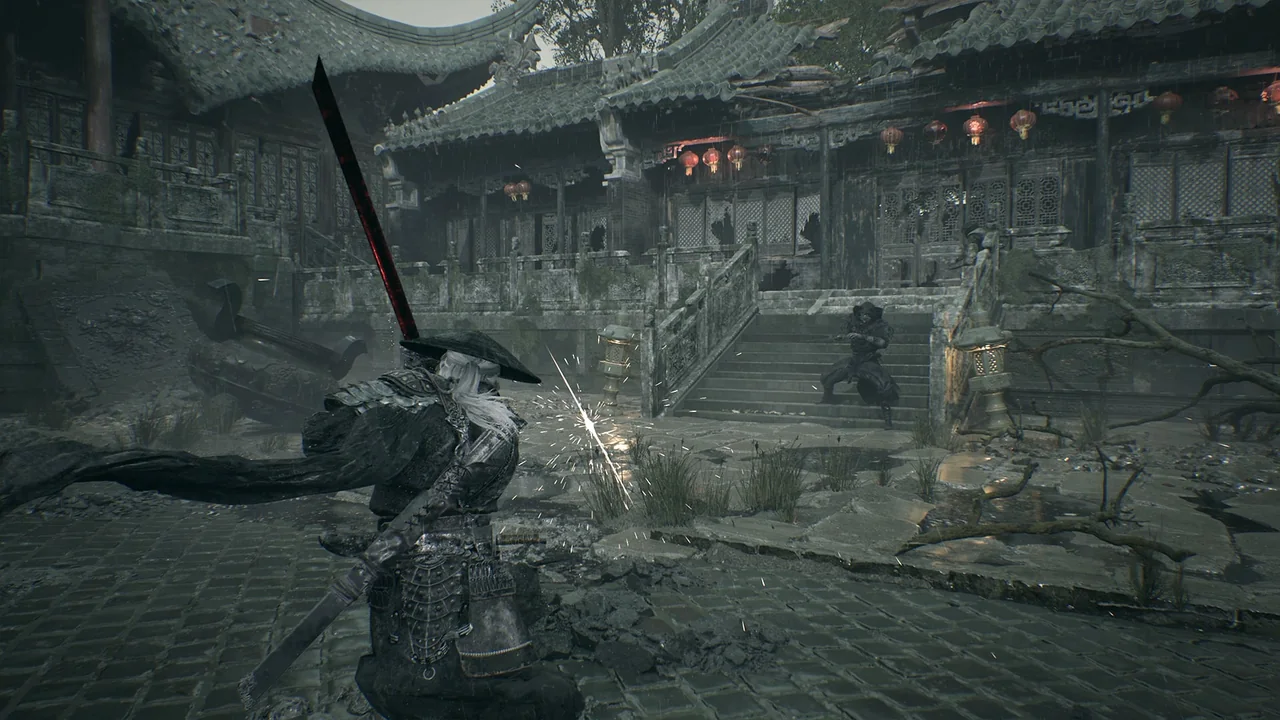
Why this page has no S-tier list
Because nobody has measured it, including us. Damage numbers per weapon exist in community tables, but a weapon's value here is mostly its signature effect — and effects do not compare on one axis. A blade that freezes cannot be ranked against one that refunds sha-chi; they answer different enemies.
So this page does the thing a tier list cannot: it names six weapons, states the problem each one solves, and states the catch. If your problem is not on the list, our full weapon table has all 25 confirmed blades with source and effect.
One rule from the released game shapes everything below: two main weapon slots. A recommendation is always half a build.
The six picks
| Weapon | Type | Solves | The catch |
|---|---|---|---|
| Wild Oriole Sword | One-handed | Pressure at range without committing | 10-second window only; you re-enter it every time |
| Parting Hooks | Dual-wield | Being overwhelmed while learning a boss | Black-flash attacks ignore Guard Stance |
| Outlaw Warblade | Two-handed | Attrition — you keep losing the long fight | No lifesteal against puppets, golden bodies, phantom bodies |
| Juggernaut | Two-handed | Turning defence into damage | Requires parries; a dodge-heavy style gets nothing |
| The Fanatic's Broken Blade | One-handed | Managing sha-chi while staying mobile | The drunk state cannot block at all |
| Freezing Chaos | One-handed | Enemies with one exploitable element | Hidden boss; three forms to actually learn |
Wild Oriole Sword: the early answer
Get it from Mu Xiaokui's third-phase encounter in Village of Lu — which means interacting with all five ribbons in the village first, or the extra phases do not exist.
Oriole Song is entered with heavy attack plus block and lasts 10 seconds, during which heavy attacks send out a rending blade wave. In practice that gives a one-handed weapon the one thing the type lacks: reach. You keep the fast recovery of a light blade and gain a way to hit at a distance, which is how you handle a boss whose punish window is short.
It is not a permanent answer. The wave is tied to a timed state, not to your normal attacks, so a long fight means re-entering it repeatedly and learning when the animation is safe.
Parting Hooks: the comfort pick
A dual-wield pair from Soulclaimer at the northeast docks of Pangzhen. Its Guard Stance blocks and counters automatically, which converts the game's hardest demand — reading and reacting in time — into holding a button.
The catch is explicit in the move description: black-flash attacks ignore it. That is a real limit, not a footnote: the enemies that matter most in the late game are exactly the ones with unblockable options. Use Parting Hooks to learn a region's rhythm, then expect to switch for the fight that punishes passive play.
Outlaw Warblade: sustain, with an asterisk
A two-handed sword from Jing Ye in Crimson Forest, available fairly early. Every hit restores HP, which turns a war of attrition into a fight you win by staying in contact.
The asterisk is the important part: puppets, golden bodies and phantom bodies take no lifesteal. That is not a small corner of the roster — the game's enemy design leans on constructed enemies, especially in the second half. Jagged Steel's bleed has the identical restriction, and the Livingwood Talisman only partially lifts it.
So treat a lifesteal build as a first-half tool and keep the second slot for something that works on constructs.
Juggernaut: for players who already parry
A two-handed blade from Bi Feng, the Giant Saber Commander, in Mountain of Imprisonment — the same optional boss that gates the true ending, so most players meet it anyway.
Each successful parry grants a Red Edge stack; at full stacks the blade turns red and a heavy attack cashes them in. That is the cleanest expression of the game's own logic: defence is not a pause between attacks, it is the resource.
If you dodge rather than parry, this weapon gives you nothing, and its slow recovery will feel like a penalty. It is not a beginner pick; it is a reward for a style you already have.
The Fanatic's Broken Blade: the drunk sword
From Hua Qianxiao, the Sword Fanatic, in Crimson Forest. Heavy attack plus block enters a tipsy state that restores sha-chi and converts attacks into flying swords — ranged damage that falls off with distance.
Its three-stage Power Surge is the most elaborate in the arsenal: sober → tipsy → drunk, and the drunk state cannot block at all, though it auto-dodges and boosts flying-sword damage. That trade is the whole weapon: you give up the defensive option to become a mobile turret for 20 seconds.
This is also the weapon preview coverage called the Drunken Sword. Same item, different translation in the reporting, which is why it appears under two names in older articles.
Freezing Chaos: the flexible one
From Yucong, No. 34 Twisted Puppet, a hidden boss inside the Triple Threat quest line. Threefold Shift swaps between Steel (raw damage and guard break), Chaos (burn that costs the target HP and sha-chi) and Frost (chill into freeze) mid-combo.
That makes it the single weapon that can answer an unknown enemy without a trip to the menu — the practical version of "adapt your build". The cost is real: three forms means three movesets to learn, and it sits behind a hidden boss most players will finish the game without meeting.
What to pair, concretely
The pairing logic that survives most encounters:
| If your first slot is | Pair it with | Because |
|---|---|---|
| A one-handed blade | A two-handed guard-breaker | You cover speed and armour without duplicating either |
| A lifesteal or bleed build | Anything without a status condition | Constructs ignore both effects |
| Parting Hooks | Your highest burst weapon | Guard Stance buys the window; the second slot spends it |
| Juggernaut | A fast one-handed blade | Parry windows and combo windows are different moments |
Beyond the weapon itself, the combat guide covers the sha-chi and Ghoststep layer that decides whether a pairing works, and the parry guide drills the colour cues that weapons like Juggernaut depend on.
What is not confirmed
| Question | Status |
|---|---|
| A measured damage-per-second ranking | Does not exist in any source checked |
| Whether upgrade level changes a weapon's effect or only its numbers | Partly — new abilities unlock at 5/10/15/25, exact scaling is not published |
| Whether Soul Tempering can be reversed | No evidence it can — described as permanent |
| Whether late patches rebalanced any of these six | No evidence either way |
Sources
- GameSpot: how to get all weapons — locations, perks and Power Surge descriptions for 19 weapons
- Fextralife: weapons — type split, switch cooldown, per-weapon notes
- Game8: list of all weapons — stats, upgrade levels, Soul Temper
- Push Square: how difficult is Phantom Blade Zero — difficulty curve context for the comfort picks