
What the announced combat system establishes
Phantom Blade Zero combines martial action choreography with an equipment system. S-GAME's June 2024 overview specifically describes reactive parrying and dodging, combos and executions using simple inputs, and a loadout of two main weapons plus two Phantom Edges. These are useful foundations for understanding the previews.
The August 2026 developer article adds upgrades, accessories, ranged approaches, and summons to the announced build options. Its weapon count describes the planned arsenal, not how many items a new save receives. For a first-session plan, begin with the beginner guide.
Is Phantom Blade Zero a Soulslike?
Developer S-GAME explicitly describes Phantom Blade Zero as a fast-paced Kungfupunk Action RPG (ARPG) rather than a traditional Soulslike. While it features challenging boss encounters, handcrafted semi-open maps, and intricate defensive mechanics, several core systems distinguish it from FromSoftware-style titles:
- No Punishing Stamina Bar: Soul is not constrained by a sluggish green stamina gauge limiting basic sprints, dodges, or offensive swings. Combat focuses on relentless, fluid wuxia choreography.
- Fluid Combo Chains and Simple Inputs: Complex aerial and grounded combos execute through intuitive button strings rather than deliberate frame-delayed commitments.
- Dynamic Deflection & Mobility: High-speed wall running, phantom dashes, and responsive parries allow aggressive offensive momentum rather than purely patient defensive attrition.
- Multiple Difficulty Modes: S-GAME officially confirmed three difficulty options (Wayfarer, Hellwalker, and Sixty-Six Days), ensuring accessible story enjoyment alongside hardcore action challenges.
For details on defensive timing and parry mechanics, see our parry practice guide.
Separate four combat questions
| Question | What to examine in a playable build |
|---|---|
| Can the action reach the target? | Starting distance, target movement, and whether contact occurs |
| Can Soul respond before the next attack? | The action's actual follow-through and the next accepted input |
| What does the action consume or restore? | Resource readings before and after an isolated use |
| What changes when the enemy changes? | The same action against another target, rather than a different sequence |
Treat these as observation categories. They do not assign hidden statistics to an animation. A wide-looking swing does not prove a fixed coverage angle, and a dramatic hit does not prove the highest posture damage.
The combo practice guide uses this separation to make sequences easier to evaluate. The parry guide focuses on defensive timing.
Reading the preview HUD without guessing its rules
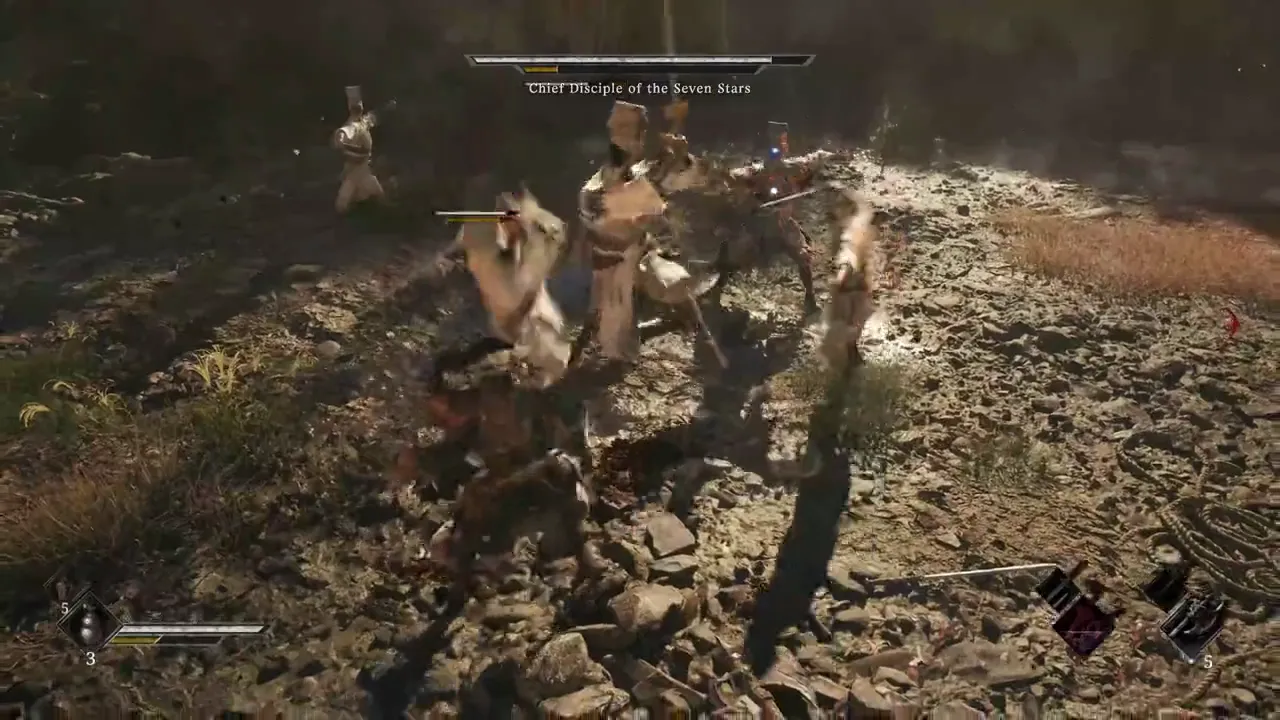
This selected gameplay frame shows the Chief Disciple of the Seven Stars target label with horizontal bars near the top, player-side bars and a counter at the lower left, and two tool icons with numerals at the lower right. It is useful for locating interface information while watching the encounter.
The frame alone does not identify every meter's official English name or demonstrate how it fills, empties, or resets. It also cannot prove maximum healing capacity, invulnerability during an execution, or whether a numeral means ammunition, charges, or another resource in every situation. Those details need a tutorial explanation or a sequence showing the change.
When evaluating a resource, compare the display before and after one action. Avoid testing an attack, dodge, tool activation, and enemy hit simultaneously: several events make the cause of a meter change ambiguous. For the encounter itself, see the Seven Stars preview.
Building a loadout and interpreting reforging
Main weapons and Phantom Edges occupy separate parts of the announced setup. Learn the role of an equipped tool before treating it as a universal answer to enemy attacks. A projectile shown hitting one opponent does not establish that it always interrupts a boss.
S-GAME says an upgraded weapon can be reforged, its materials recovered, and those materials reinvested. Read the actual confirmation screen before changing a build. The announcement does not provide every currency rule or a blanket guarantee about dismantling all equipment.
Our Phantom Edges guide distinguishes confirmed secondary-tool options from missing refill and interruption rules. This overview will need release-build evidence before it can become a complete mechanics reference.
Sources
Sources checked October 11, 2026. Practice suggestions in this guide are editorial guidance, not release-build test results.